Scotland
Location: Scotland, UK
Duration: 3 days
Type: Educational travel

In the fall, Arseny started 12th grade — which meant that September and October were devoted to the college application process. As is common here, students tend to divide their prospective universities into categories: “schools where I’ll definitely get in,” “difficult but realistic,” and “dream schools — almost a lottery.”
Based on their grades and achievements, most high school seniors have a fairly good idea of which category each university falls into for them, considering its requirements and level of competition.
Overall, the process is complicated, begins long before 12th grade, and will probably deserve a separate story of its own someday. For the purposes of this trip, however, the important part was that by the end of November, alongside the first responses from universities in the US and England, Arseny received two particularly important offers of admission from Scotland — one from The University of Edinburgh and the other from University of St Andrews.
St Andrews had always been in his “dream school” category, since it is considered the strongest university in the UK for his field and one of the strongest in the world.
At the same time, we had never even been to Scotland before, so for Thanksgiving we decided to make a quick reconnaissance trip.
That made our short journey feel less like “travel” and more like “a brief introduction to universities.” The three of us flew together this time, along with my mother. Little Ilyusha stayed home.
We flew directly to London. London itself was only meant to be a transfer point on our way to the Scottish capital, but since we arrived almost at dusk, we decided to spend the first night there and continue on to Edinburgh the following day.
I booked a hotel right in the center, near Buckingham Palace, so that after the long flight — and before the long train ride — we could stretch our legs and walk through the city, starting from Paddington.

and then continue the next day to King's Cross Station.
Back home, we had left right after a terrible windstorm that had knocked out power in several towns, including ours, and we arrived in London to much of the same windy weather. Even so, we thoroughly enjoyed our walk through the city.

We walked through Hyde Park and past all the landmarks we had already seen on our previous visits.

In London, it was full-on autumn — real, unmistakable autumn. Beautiful.

The next day, after a good night’s sleep and breakfast at the hotel, we set off straight for King’s Cross Station — passing Buckingham Palace, Green Park, and along Piccadilly. Everything was beautiful.

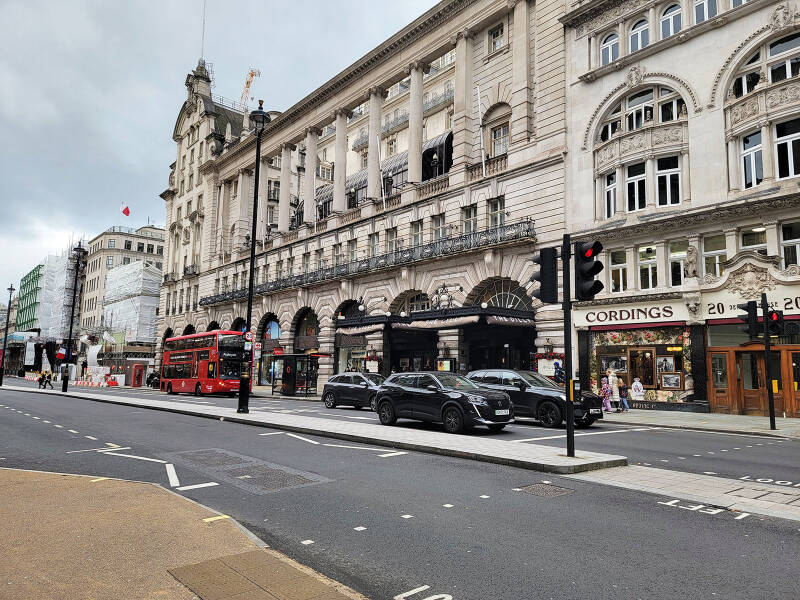
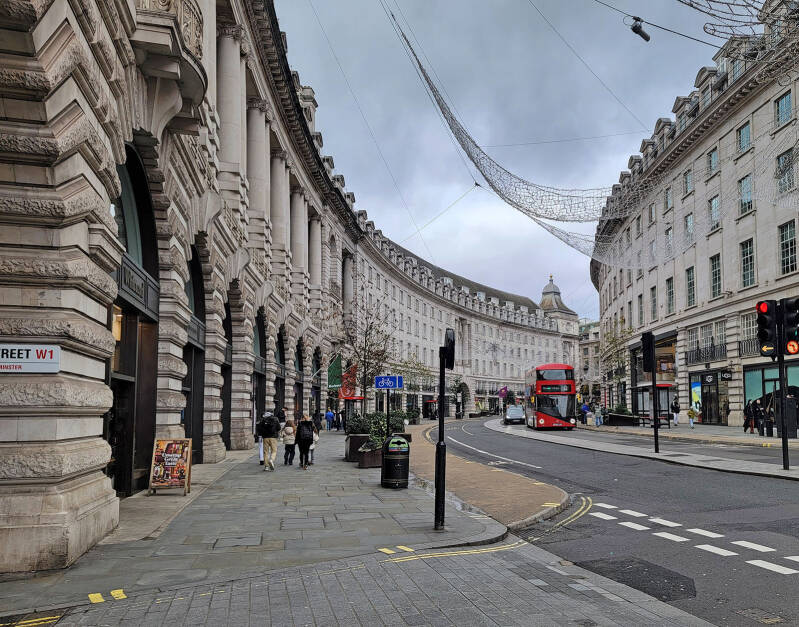
The train to Edinburgh takes about 4.5 hours. It was very comfortable — warm and spacious. And finally, we arrived in Scotland!
How wonderful it was that we saw Edinburgh for the first time not in summer, but right now, when the whole city is sparkling with Christmas lights.


Such an explosion of colors across those winding medieval streets, cathedrals, fortresses, and castles! Everything constantly shifts and shimmers in the changing light. I honestly don’t even know what to compare it to. You step out of the station, and your jaw just drops.


Right at the station, Arseny was met by his girlfriend, who — being a little older — was already a first-year university student.
We checked into an apartment not far from the station, and then almost immediately went our separate ways. My mom and I decided to squeeze in at least a short walk along the Royal Mile.


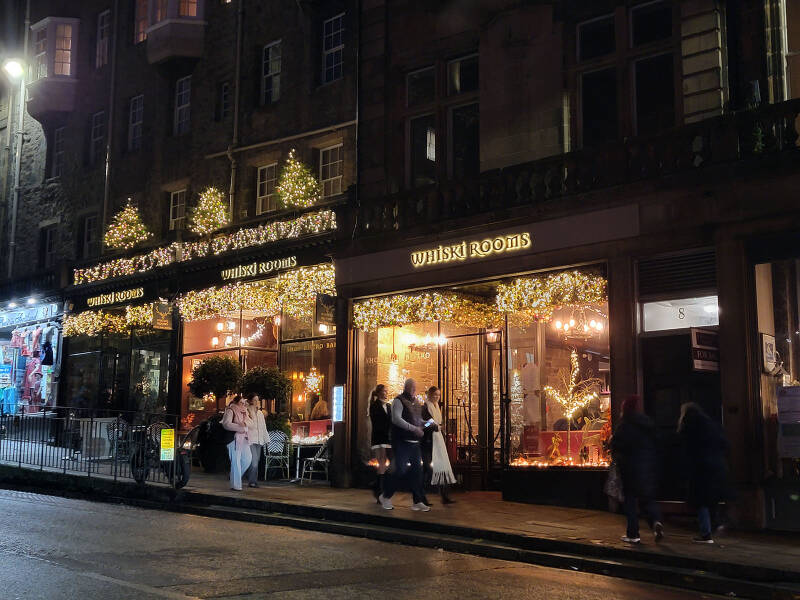
The wind here was even stronger than in London or Seattle. It felt like we were constantly pushing against air resistance — every step was a small struggle. But it didn’t dampen our mood at all. We still enjoyed the walk thoroughly.


In the morning, we planned to visit Edinburgh Castle. We walked up to it, but it turned out to be closed due to stormy winds.

The wind really was absolutely brutal up on the hill — right at the entrance to the fortress it was literally strong enough to knock you off balance. Still, they could have let people inside the castle. It was a real pity. We were disappointed and walked back down the Royal Mile, going into churches, shops, and cafés along the way.


After lunch, we headed to a tour of University of Edinburgh — or rather, we dropped Arseny off there, while decided to explore the campus on our own. The idea of using Thanksgiving for college visits clearly wasn’t ours alone, so the large groups of prospective students were made up almost entirely of Americans — both in Edinburgh and later in St Andrews.

The University of Edinburgh is located right in the very center of the city, while many of its buildings and student residences are scattered well beyond the center — meaning the university is woven into a large, active tourist city. This is very different from, for example, Cambridge, where the entire surrounding environment feels subordinated to the university itself.
Founded in the 16th century, it consistently ranks among the world’s top 30 universities according to various rankings such as QS World University Rankings and Times Higher Education.
During the tour, Arseny learned that the university was home to the first student union in the world. It is also where Charles Darwin studied before moving on to Cambridge — and it was here that his studies first led him to question religious doctrine. Arthur Conan Doyle also studied here. One of the university’s departments was where Dolly the sheep was cloned, and it was also where Peter Higgs worked and taught — the physicist after whom the Higgs boson was later named.
And that’s not even mentioning the many graduates who went on to become ministers and prime ministers of England and Scotland. In short, the university has a long and distinguished history.

While Arseny was walking with the group and learning about the program and academic structure, we (my mom and me) happened to come across a large student celebration ceremony. There we discovered that academic and student gowns follow quite elaborate rules: they can be black and white, or black with various colored accents — red, yellow, blue, two-tone combinations, and so on.
Since we weren’t on the official tour, no one had explained this to us, but with ChatGPT on hand we looked it up and learned that the colors of the hoods and trims on academic gowns vary depending on faculty and discipline. The gown styles also differ between undergraduates, future master’s students, and doctoral candidates. Those with special honors or degrees receive additional decorative elements on their robes. In short, everything looks very colorful and beautiful.
And overall, when you look around while being in student Edinburgh, you start to understand why the atmosphere in Harry Potter feels the way it does — the first book was actually written here, in a café nearby, by J.K. Rowling.
(By the way, some scenes of Hogwarts were filmed at the beautiful Durham University — from which Arseny has also already received an offer, though that’s already in England.)


After walking through the campuses and parks, we came to the conclusion that this beautifully scenic university is deeply integrated into the fabric of the capital. Here, students are fully mixed with local residents and noisy tourists alike — in other words, they live in the very heart of a major city, with all its advantages and drawbacks.


People are different, and for some this kind of location is a real advantage for a university, while for others it isn’t. We knew that Arseny was looking for a more enclosed, atmospheric campus setting, somewhat separated from the outside world, and we already had a sense that his overall impression would be somewhat mixed. And that’s exactly how it turned out.
The next morning, a miracle happened — the brutal wind finally died down and gave way to complete calm. This opened up new possibilities for us: we remembered our planned walk to Arthur's Seat, the trail that leads straight from the city up to an ancient volcanо


We had about two hours before our train to St Andrews, so we hurried up. And the hill was absolutely worth the visit — with such spectacular views over the city and the sea! Even here, in nature, there was a sense of ancientness, almost a sacred quality to the place itself.


The way down turned out to be more difficult — my city shoes were completely unsuited for the overnight-frozen volcanic slopes, and I was slipping badly for the entire first half of the descent.
Once we were back in the city, we headed straight to the station. The train from Edinburgh to St Andrews takes exactly one hour. But since it gets dark very early in northern latitudes in winter, we arrived again at dusk. And we immediately stepped into a quiet, dark medieval world. God, how beautiful it was — how much I love it.

We checked into a room right in front of the cathedral ruins, with the sea just behind them.
Long ago, in the mid-4th century, there lived Saint Regulus, who saw an angel in a dream. The angel told him to take the relics of Saint Andrew the Apostle and bring them to the ends of the earth. And so Regulus did — sailing all the way from Greece to these very shores. In honor of Saint Andrew, the small village that grew up by the sea was named after him. Saint Andrew later became the patron saint of all Scotland. And the Andrew’s cross, on which he was crucified, is familiar to everyone — the X-shaped cross.
Our room, although the most budget-friendly of the entire trip, turned out to be a spacious apartment with two bedrooms and a large living room (what a difference in prices after London). It’s a mystery how the homeowners manage to pull off such impressive renovations in their old grey stone buildings. Though with very high ceilings, large windows, and fireplaces, everything else is just a matter of execution.
Of course, we ignored the darkness and went out to explore the town — and, hooray! instead of depressing Tesco and Sainsbury’s, there were proper grocery stores. At last! We stocked up on food and fed the kids.
Our first impression of the town at night was that it seemed to be made entirely of clever, studious students. To me, that is the most wonderful thing in the world — an atmosphere of peace, order, quiet, and beauty, and yet still youth and freshness.
In the morning we went on a university tour. This time I couldn’t miss it — Arseny only has three dream universities, and here there is also a significant personal factor involved, so the chance that he will spend the next four years here is quite high. Although I won’t make any predictions.

The first part of the tour was led by girls in their third year of studies. You could tell that by the way they were wearing their red velvet student gowns — which, unlike the silk gowns in Edinburgh, looked more like warm, wide coats.

Second-year students wear their gowns slightly slipped off the shoulders, as they have already gained some confidence and independence over the year.
In the third year, only one shoulder remains covered — either the left or the right, depending on the faculty. (The right side is associated with the “hard sciences,” which are considered always right, while the left is for the humanities, closer to the heart.)
In the final year, both shoulders are left free, symbolizing full independence and readiness to step into the wider world. Our guides were from Physics and Classical Literature, so their gowns were draped differently, with opposite shoulders exposed. There are all kinds of traditions that accumulate when you are dealing with one of the oldest universities in the world.
The University of St Andrews was founded in 1413, making it the third oldest university in the English-speaking world after Oxford and Cambridge. It does not rank as highly in global rankings as Oxbridge (although in the UK rankings it often does, and sometimes even surpasses them), not because it is weaker, but because it offers a very limited range of subjects. For example, it has no engineering or many applied fields, which does not align with the criteria of most ranking systems.
However, in the disciplines it does offer, it enjoys an exceptionally strong reputation — often even stronger than that of the University of Edinburgh.

The more we walked from campus to campus, and the more I saw and heard, the more I felt that I could send Arsya here with complete peace of mind — the spirit of this place suits him perfectly. And I think Arseny felt something very similar.
We were told about student traditions and rituals, shown a living tree planted here by Mary, Queen of Scots in 1563, and introduced to the brass letters “PH” embedded in the cobblestones in the center of town.

You must never step on them — this is the spot where the heretic Patrick Hamilton was executed, and the place has been considered cursed ever since. Anyone who steps on it is bound to fail their exams. The curse can only be lifted by running through the fountain near the Chapel of St Salvator.
We were told about traditions of swimming in the North Sea and foam battles, about 150 student clubs for every possible interest, and about how tenderly the university treats its first-year students — every incoming student is assigned a “mother” and “father” from the third year who look after them, entertain them, and help them find their footing in the early days.
These “mothers” and “fathers,” in turn, follow old traditions of their own: they stage their own “weddings,” dress their “children” in funny costumes, and generally have a great time.
It almost goes without saying that the faculties are housed in incredibly beautiful ancient buildings — and walking through them, you can literally feel their rich history in the air.

We were shown the residence where the current Prince of Wales and future King of England, William, lived while studying here on the Art History program. It was also here that he met his future wife, Catherine, Princess of Wales (Kate Middleton).
More than half of the town’s population consists of students. The rest, naturally, is in one way or another connected to student life — whether working in cafés, libraries, hair salons, and so on. The entire picturesque town can be walked across in about half an hour, and wherever you go, you eventually end up either at the sea or at vast golf courses.
In fact, in the summer, when students leave for their Summer break, the town fills up with golfers from all over the world.
We listened to the second part of the tour in a lecture hall. It focused specifically on the program itself, the courses, and the timeline for studying them (Arsya absolutely loved all these details — it turned out that the subjects he doesn’t particularly enjoy could be skipped entirely, while he could focus as much as possible on the ones he truly loves).
After the tour, the kids went to see the dormitories (the option of a single room with a private shower warms my heart), while mom and I went for a walk along the seafront. It was just too beautiful there.
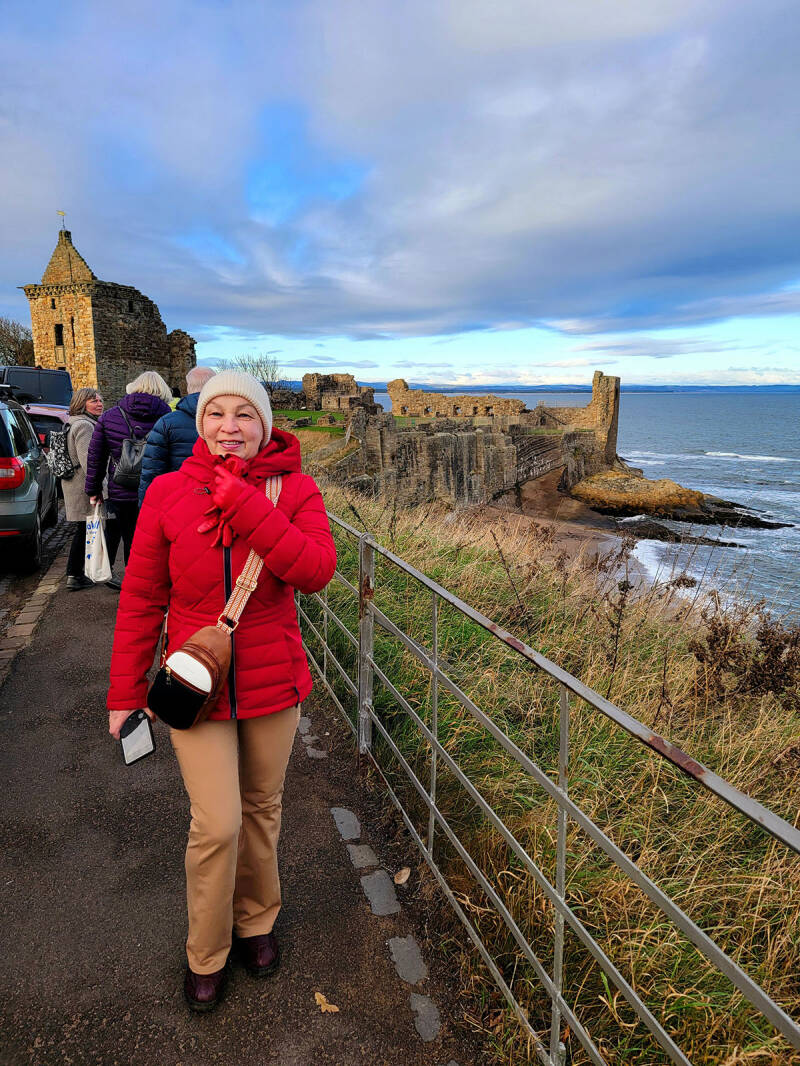
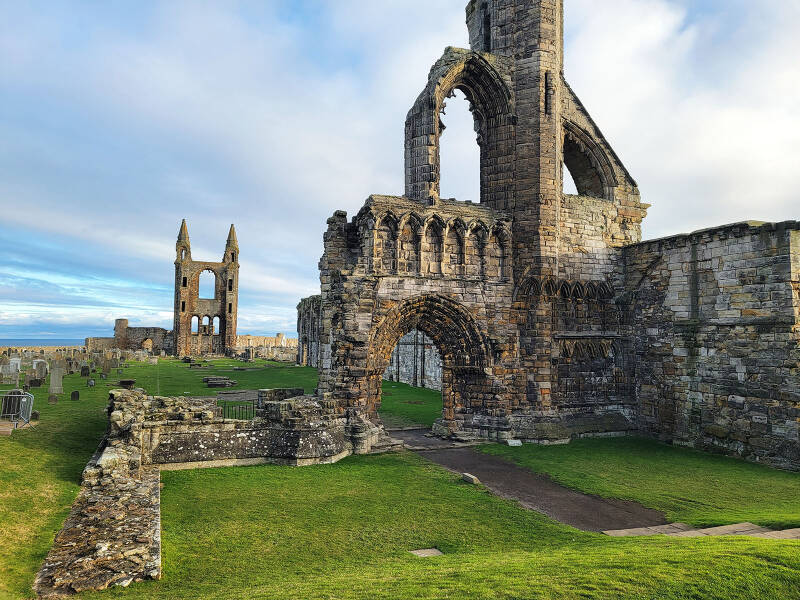
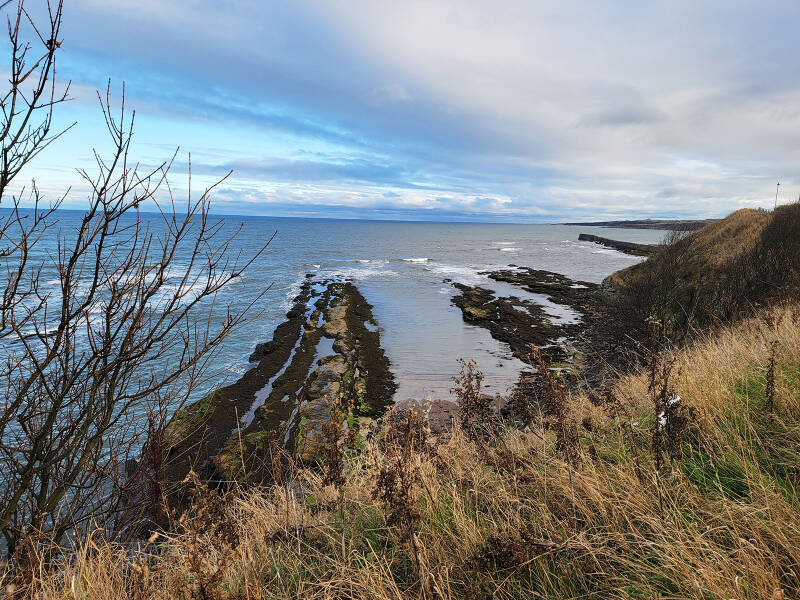
We spent the evening together as well, just my mom and me, walking around town and exploring the local shops. The town truly has everything needed for a comfortable student life.
The next morning we checked out of the apartment — that day we had a long journey ahead of us back to London Airport. The kids managed to squeeze in a quick visit to a museum and another walk around town in the morning, while we relaxed in a café before beginning our return trip: first by train to Edinburgh, then on to London, and finally to Heathrow. We spent the night at an airport hotel and flew home the next day.
It turned out to be such a lovely trip. When Arsya is happy, I’m happy too.
Create Your Own Website With Webador